All projects
Electronics and making
2026
Two builds from my desk at home: a motorised door lock with a wireless ESP32 button, and two Tesla coil kits I soldered myself.
Role
Concept, electronics, programming, build
Tools
ESP32 · Servo motor · 3D printing · Relay module · Soldering iron
Themes
Home automation · Mechanics · High voltage
Year
2026
Built at home
Next to school I keep a small workbench at home, with a soldering station, breadboards and a wall rack of tools. It is where I learn the electronics I later use in interactive work.
Smart door lock
In January and February 2026 I motorised the sliding bolt on my bedroom door, so I can lock and unlock it with a button.
How it works
An ESP32, a small microcontroller with Wi-Fi, drives a micro servo. A servo only rotates, so a gear on it pushes a 3D-printed toothed rack that slides the bolt: a rack and pinion. A second ESP32 with a red button is the wireless remote, and a relay switches a red LED strip on my desk that shows whether the door is locked.
I built it in small steps: the ESP32 and servo on my desk, then the remote with the servo held in a clamp, then the full mechanism on a board beside the door frame.
Tesla coils
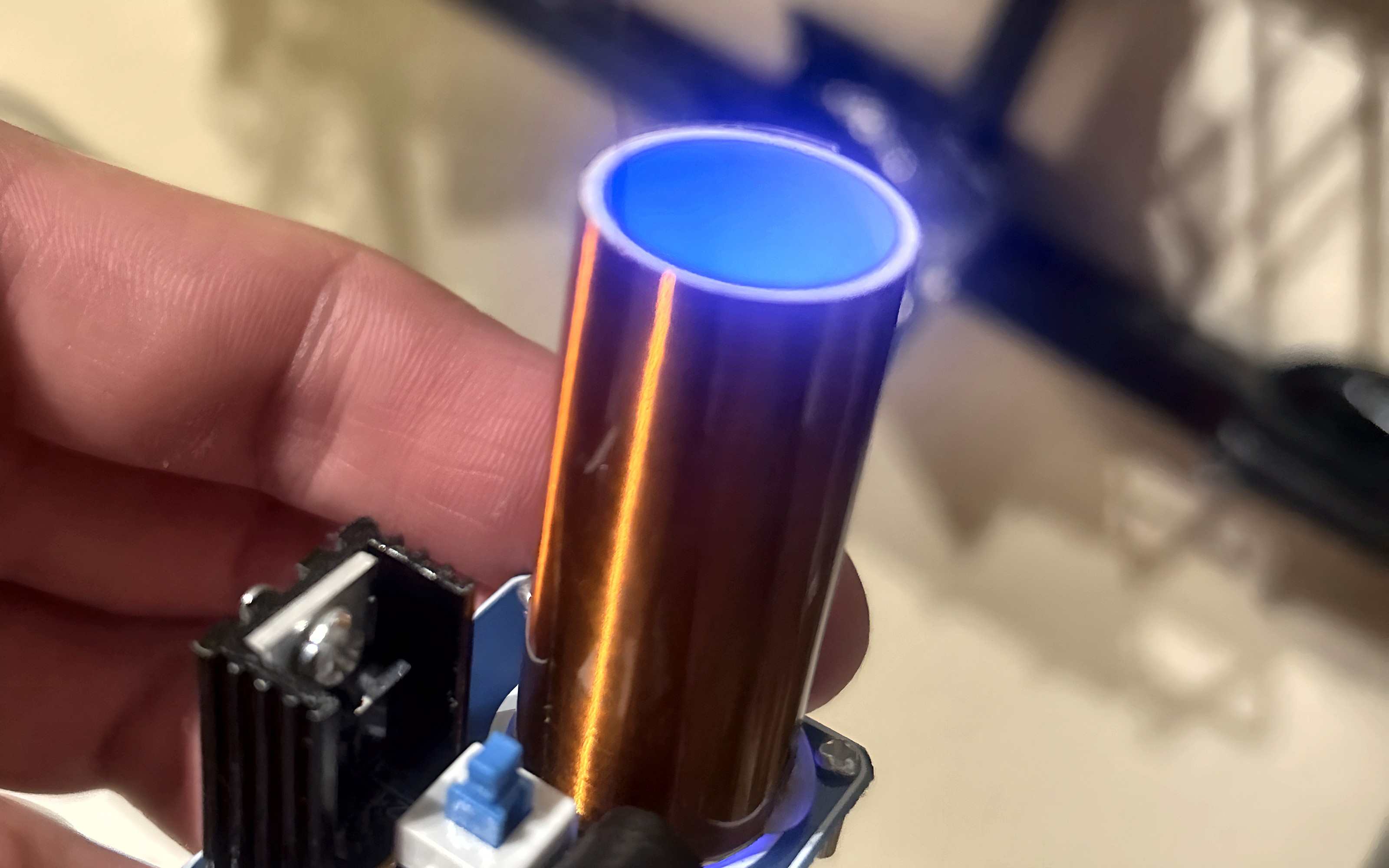
In April and May 2026 I soldered two Tesla coil kits, to practise soldering and understand high voltage: a small coil driven by a single transistor, and a musical coil with an audio input.
How it works
A Tesla coil is a resonant transformer. A transistor switches current through a primary coil of a few turns, very fast. When that rhythm matches the natural frequency of the long secondary coil, the voltage at its top climbs very high. In the musical coil a PLL circuit keeps the drive locked onto that frequency, and the audio signal modulates the spark, so the spark itself plays the sound.
What I took from it
The lock taught me to turn rotation into straight motion and to build in testable steps. The coils taught me to read a circuit board and solder carefully. Both return in my interactive projects, where motors and electronics have to work every time.


Next project

© 2026 Noaquim Brouwer — Immersive Applications, Nimeto